A first blog had to happen eventually…
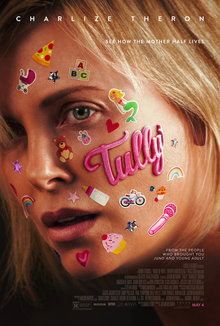
I’m (finally getting around to) writing about Tully (2018), directed by Jason Reitman, written by Diablo Cody, starring Charlize Theron, who this time is also one of the credited producers. This is the same creative trio behind Young Adult (2011), which was one of the best films of that year with a stunning performance from Theron, which somehow failed to land an Oscar nomination for her, which seemed scandalous then and hasn’t seemed much better with the passage of time.
Tully continues a similar theme dealing with issues which remain generally absent in mainstream cinema, namely, realistic and flawed female protagonists who aren’t written to appeal to the audience in a straightforward manner. These are, to some minds, unlikable characters. But they’re not really, they’re just recognisably human.

Tully deals with the final stages of a pregnancy, and first few months post-birth. It brings us Marlo’s (Theron’s character’s) point of view, which is claustrophobic and upsetting. Marlo’s house is all browns, oranges, it’s fuzzy around the edges, but the shots are clear and sharp, is it a womb/cocoon/trap, and she spends much of the film here. Anchored in this building. When the film opens, she’s pregnant with her third child, and her life seems barely able to contain what’s already in it. The film plays with fantasy sequences, one of which involves a mermaid, a symbolically significant creature through its absence of genitals which suggests an unencumbered self, untroubled by the difficulties that are part and parcel of having genitals – reproduction and birth.
The crux of the film, and the ‘Tully’ of the title, is the character played by Mackenzie Davis, who arrives as a night nanny recommended by Marlo’s brother (Mark Duplass). Marlo is tired, and her brother fears she cannot cope. This raises questions of the immaterial labour of motherhood, and female identity. Marlo’s husband (played by Ron Livingston) is not a ‘bad guy’, but he is necessarily detached from the everyday experience of his home and his family as he spends much of the day elsewhere, at work. He has outsourced the burden of maternal care disproportionately, something that is mirrored in many/most families. The film shows a marriage with flashes of synchronicity, but also with an accepted pattern that perpetuates this distance. Tully’s arrival explores a further level of outsourcing, and aspects of the plot deal with the outsourcing of both parenting and sex.
Charlize Theron painfully portrays the fatigue of Marlo as a new mother. Her tired apathy and her ambivalent relationship with the newborn is palpable, and anxiety-inducing. It’s only when Tully the night nanny comes along, and pointedly asks what the baby’s name is, does it occur to us that we didn’t know this. Marlo too looks taken aback, it’s the first real spark of interest in the new life she’s produced.
Through Tully’s presence, Marlo experiences a rejuvenation. This re-awakening causes Marlo to explore her past and evaluate it against her present. She’s continually provoking the audience to consider their own past selves and the choices they’ve made. Are we happy, and, more difficult, would past us think we’re happy? What did we want ten years ago and how would that feel now? The writing is just bliss. We meet Marlo in her slump, but we can clearly see who she was before, and we mourn the loss of that woman.
There’s also some sharp and satisfying class commentary between Marlo and her brother and his partner (Elaine Tan). These scenes offer some truly welcome comedic notes in a film that is intense and penetrating. This set piece showcases how the characters navigate the choices of parenting, and the increasing truth that these parenting choices reflect wider values, sensibilities and lifestyles. The brother’s clumsy cultural appropriation positions him as a recognisable trope too, he truly is the ‘wokest bae’, and Duplass and Elaine Tan offer terrific scenes of family awkwardness.
The film’s conclusion is satisfying, more so than it has any right to be considering the narrative conceit they pull off (for me the penny dropped just seconds before the reveal).
Tully feels like the natural evolution of Diablo Cody’s characters, characters which seem to reveal stages of life she has passed through and carefully observed. From Juno (2007), to Young Adult, to a mother of three children, trying to get by in very ordinary ways. These films are a treat, they are women-centric, and absorbed in faithfully portraying a woman’s story.
Tully presents a natural evolution of women-centric storytelling from this creative team-up. The fatigued performance of Theron is compelling and convincingly conveyed and she is very ably supported by the entire cast performances.
3/5

 A Room With No View