
Bette Davis played Queen Elizabeth I, twice. Once, in 1939, in The Private Lives of Elizabeth and Essex, and again in 1955, in The Virgin Queen. In both films, the last shot is of Davis, burdened by the weight of ruling, but unbowed in her duty. The camera tracks back, and we see Elizabeth alone in a private moment of resignation.
Davis’ portrayal of the Tudor queen, who reigned from 1558 until her death in 1603, has significant shared elements across the two films. Although The Virgin Queen was released 16 years after Private Lives, it deals with events in Elizabeth’s life which occurred some years before it. When you watch them in reverse ‘making of’ order, Private Lives seems like a direct sequel. Enhancing this impression, Davis also brings a remarkably similar physicality to her portrayal of Elizabeth.
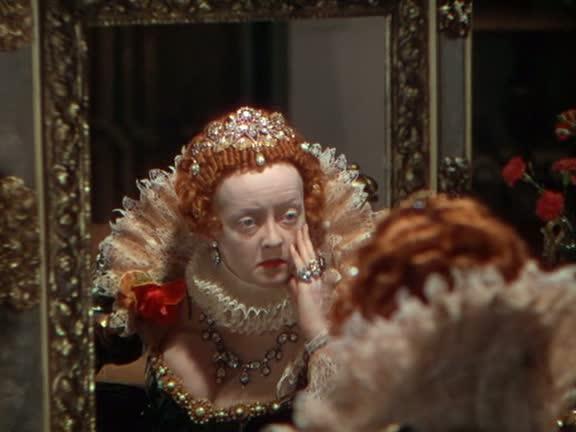
Both films also follow a similar format. Elizabeth is cast as a romancing (preying) female, drawn to male subjects in her court over whom she exercises possessive authority. In both films, Davis, perhaps unsurprisingly, outshines the male lead – Errol Flynn in Private Lives and Richard Todd in The Virgin Queen (easily outshines in the case of Flynn). Flynn and Todd play the Earl of Essex and Sir Walter Raleigh, respectively – men who catch Elizabeth’s eye and become court favourites.
In The Virgin Queen, the film explores Elizabeth’s attraction to Walter Raleigh, her attempts to control his career and ambition, and her rage at his relationship with and secret marriage to a lady in waiting (played by Joan Collins).
In Private Lives, the male lead is Essex (Flynn), Elizabeth likewise attempts to exert power over his career, while Olivia de Havilland plays a thankless role as a lady in waiting who fancies the Queen’s man, albeit without much success.
Although the basic plot outlines are similar, there are considerable differences in how the character of Elizabeth is written in each. She’s imperious and difficult in both, of course, she’s the Queen, but the character is more sympathetic in Private Lives. In Private Lives, she engages in a largely chaste courtship with Essex. When his life is in peril, she is desperate to save him, and for him she is willing to offer her throne and sacrifice country for love. It’s a slightly ridiculous element of the character, and not entirely consistent with how she is written up to that point. In The Virgin Queen however, the character of Elizabeth has less screen time, and her presence is felt in the lives of the characters around her, for whom she is a source of terror, a tyrant who rules their destinies. A plot device familiar to monster movies – keep the object of fear at bay lest it lose its power. She is definitely not the romantic female lead – that part goes to Collins’ character. Instead, Elizabeth is menacing and sinister, her courting of Raleigh is one-sided, and facilitated by power dynamics that allow her to push her attentions on an unwilling subject.
Private Lives – or Elizabeth as romantic lead – was released in 1939, 16 years earlier than The Virgin Queen – or Elizabeth as tyrannical monarch. It was therefore an older Bette Davis who played the arguably more interesting Elizabeth role, suggesting something about her own career trajectory. Known for her willingness to embrace the grotesque in her roles (such as Mr Skeffington in 1944 and Whatever Happened to Baby Jane? in 1962), Davis takes Elizabeth in an uncompromising direction, portraying a woman who is to be feared, a woman who is absurd and monstrous. In 1955, Davis’ Elizabeth is a very different animal to the occasionally simpering Elizabeth of 1939, and arguably much the better for it.

 A Room With No View