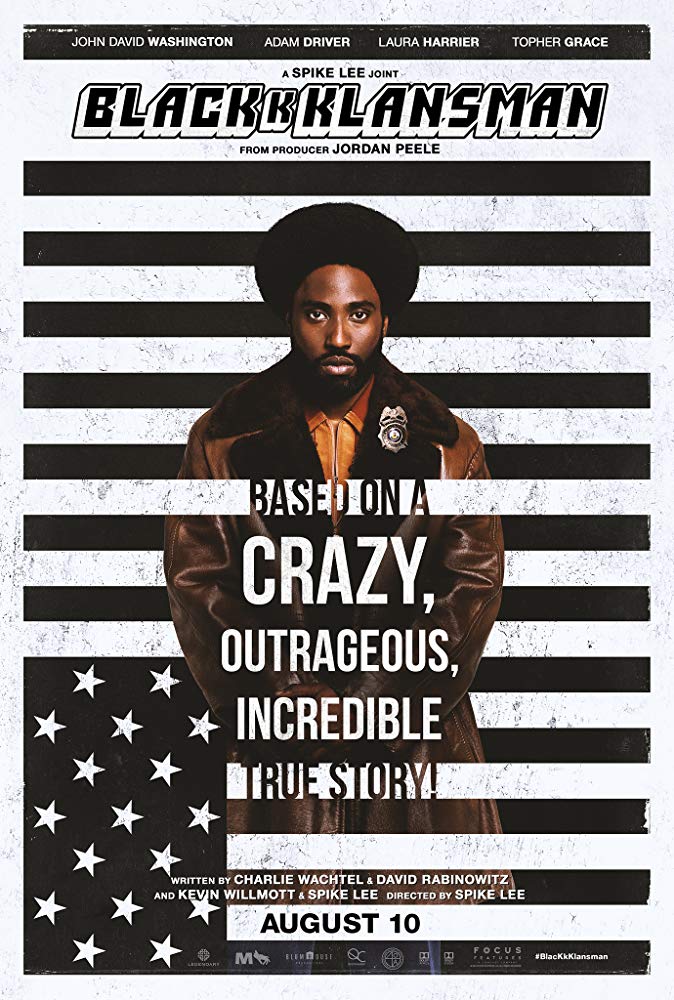
BlacKkKlansman is the first Spike Lee film I’ve seen in the cinema, and it’s not the film I thought I was going to watch. In fact, BlacKkKlansman is not what I thought it was going to be AT ALL. Maybe I didn’t watch trailers closely enough. To illustrate… There is a scene in which four cops, including our central protagonists, are debriefing after a mission, sat in front of their captain’s desk. The banter is crackling, the humour is comfortable and really draws on well-established character relationships… and I thought THIS COULD BE A BUDDY COP FRANCHISE. I wanted to remain with these guys, ride along on their next undercover mission – BlacKkKlansman 2 – Infiltrating the Rad Fems. I did not expect to watch a buddy cop movie.
John David Washington is hugely likeable – and his performance from the get-go clued me into the feel of the film. The goofiness of Washington’s character, Ron Stallworth, threw me instantly, and I had to readjust and reread the tone of the film – it’s a darkly disturbing tale but our protagonist is wearing it lightly, and there are a slew of laugh out loud moments.
There are reminders of the trauma of race relations in the US throughout, and we see images of lynching, in a scene that cross-cuts with audience reactions to watching DW Griffith’s The Birth of a Nation (1916). The message is that cultural depiction matters.
Lee is dealing with issues which go to the heart of the American experience today, which is struggling with a past and present, and a seeming inability to reconcile or acknowledge an original sin. Lee uses one exchange in the film to bring this home. It’s an obvious reference to present day US politics and the ascension of Trump. Does it work, as a natural exchange between the two characters? I’m not entirely sure. But I don’t think I care, because it’s a time stamp for viewers in the here and now. Likewise, footage from the Charlottesville protests of 2017 close the film and feel necessary. Lee implores his audience to think.
The score, by Terence Blanchard, is great. The main hook is compelling and reminded me of a proper early ’90s thriller. It looks beautiful too, hardly surprising as the Director of Photography Chayse Irvin worked on Lemonade.
The central performances are really good. Washington takes us with him and is an endearing lead – he plays it as always veering towards being out of his depth, while pulling off his endeavours regardless. Adam Driver is the young ‘old hand’ detective, cynical and with his years of undercover experience. His performance is incredibly nuanced, as he conveys both confidence and questioning. Laura Harrier as the female lead gets a slightly thankless role. She’s in danger. She needs saving. She educates Ron. It would have been nice to see her do more, maybe she can get more to play with in BlacKkKlansman 2 – Infiltrating the Rad Fems.
In a tiny role, Corey Hawkins is physical and emotionally commanding as Kwame Ture. And Isiah Whitlock Jnr gives fan service to those who love The Wire.
For our racist antagonists, the cartoon villainy of Jasper Pääkkönen as rabid dog Felix is nowhere near as terrifying as the cool rationality of Ryan Eggold’s Walter. A klansman who is competent, and all too human. Topher Grace as David Duke, too, brings smarm and slime, and presents the more acceptable face of racism.
One bum note comes towards the end, and suggests that police brutality is more about ‘one bad apple’ than institutional racism. It’s a forced resolution that conveniently deals with the one racist cop in the police department, and it presents an idealised view of race and policing that fails to really capture the complexity of this issue. It also feels out of touch with contemporary US racial politics – in a way that Lee seems eager to embrace elsewhere.
On the one hand, BlackKklansman is an enjoyable and well-acted buddy cop movie, and on the other hand, it’s a thoughtful treatment of race in the contemporary America. Spike Lee has done something quite special here.

 A Room With No View