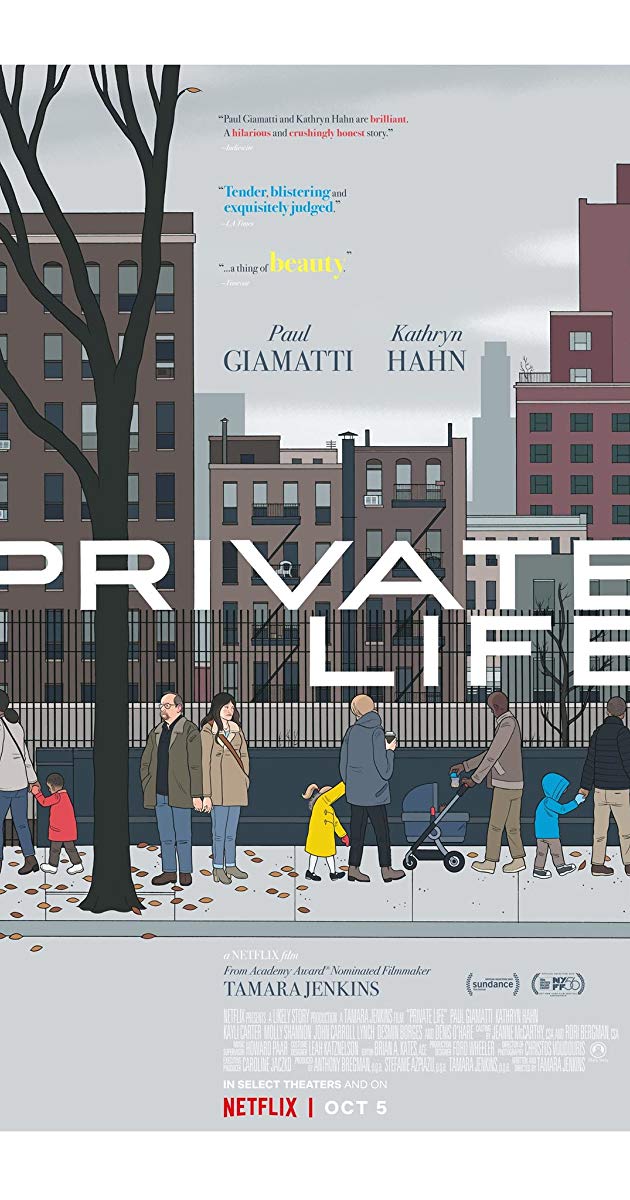
I sat down in the comfort of my own home through the week to enjoy the brand spanking new release Private Life, written and directed by Tamara Jenkins. Because Private Life is one of a slew of films produced and distributed recently in co-operation with Netflix such things are becoming increasingly common. Nicole Holofcener’s The Land of Steady Habits also premiered recently on the streaming platform. Whatever the merits of this development, and the question is much debated currently, it does mean ‘new releases in pyjamas’ is a possibility. Incidentally, the two most recent new releases I’ve watched which are directed by women (this, and Steady Habits) were both released through Netflix rather than a traditional theatrical release.
Private Life follows Kathryn Hahn’s Rachel and Paul Giamatti’s Richard, a couple in their 40s who are investing their bodies, their time and a considerable chunk of their money into attempts to become pregnant. Hahn and Giamatti are in almost every scene, and they are almost always together. It was only when I was searching for a picture online of Hahn on her own (because I wanted a shot of her amazing hair), that I realised how much the film presented them as a unit throughout. The toll of their efforts and emotional investment in having a child is telling on them as a couple, but while they appear together as a constant, the burden is felt differently by each, a gendered experience which inevitably creates tensions in their marriage.
Rachel and Richard are soon joined in this fraught private life by their step-niece Sadie (played by Kayli Carter), who is directionless and in her 20s, and who very quickly becomes the manic pixie dream egg donor.
The film skewers the commercialisation of reproduction; infertility treatments are an industry, and adoption is a social media popularity contest. Ethical issues suggest themselves, but aren’t examined in any great detail. For instance, while Rachel and Richard are clearly aware of the sensitivities of asking Sadie to be an egg donor, they ask her anyway. Indeed, neither Rachel nor Richard are initially willing to examine their own complicity in any ethical questions arising from their desires.
The film is less interested in these questions than in the psychological twists and turns infertility wreaks on those involved. One recurring note was the comparisons women made, as they judged themselves against their peers, in measures like physical appearance and sexual appeal, as well as on their ability to reproduce. The film also explores interesting questions of ownership. If Rachel were to have a donor egg implanted, to whom would the baby belong? Whose egg would be acceptable for such an undertaking? Which egg donor is not a threat to her marriage? When Sadie declares herself willing to give her own eggs, how much bodily autonomy does she surrender? For Sadie’s mother, to what extent does Rachel’s link with her daughter threaten her own maternity? For Rachel and Richard, Sadie is an adult who can help them to have a baby… but for her own mother, Sadie is the baby.
For a film about the endurance sport that is infertility treatment, there are some very funny moments. A few scenes in particular had me laughing out loud, scenes which generally coincided with Molly Shannon being front and centre. The central trio of Rachel, Richard and Sadie are a pleasure to watch when they are onscreen together. Sadie’s entry brings energy and hope to the oh-so-tired Manhattan apartment. The relationship between these three is intimate and affecting, and forms the emotional backbone of the story, allowing Rachel and Richard to think of someone other than themselves, offering them a chance to parent, and a chance to laugh. Private Life follows its protagonists through emotional and physical turmoil, charting a monomania that is exhausting. At its close, we may not know how it will end, but we can at least hope they are on the same side.
Private Life is an unshowy, sensitively realised, and wickedly funny portrayal of one couple’s fertility journey. The performances and the script are all that matter, and they are superb.

 A Room With No View