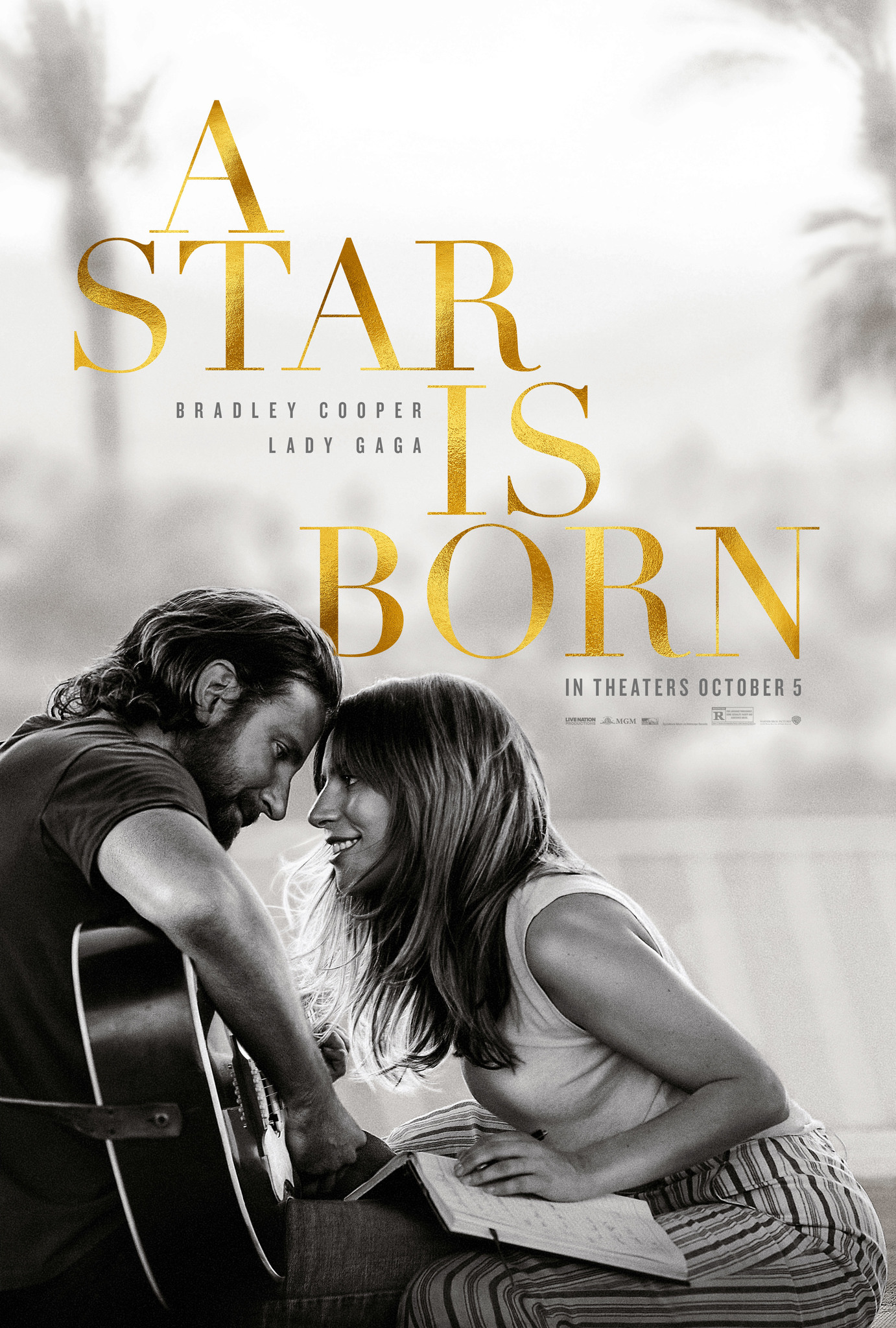
I have a lot to say about A Star is Born. My initial reaction was that it wasn’t necessarily what I expected it to be (awful review opener, I know). For one, I didn’t love it as much as I thought I was going to love it. Or, maybe, I mean I wasn’t ‘affected’ by it like I expected. I had actually been reluctant to see it because I thought it would worm its way into my emotional centre (like Titanic did and still has the power to do). When it came to it, it didn’t really get me like that.
Before we begin, be warned, this review has spoilers and many, many references and comparisons to the three previous films (Janet Gaynor and Fredric March in 1937, Judy Garland and James Mason in 1954, and Barbra Streisand and Kris Kristofferson in 1976).
What I loved about it, though, was Bradley Cooper, who I thought was just brilliant. More than any of the other versions, I thought that this iteration was most his story. There is a scene in American Hustle (2013, dir. David O. Russell) in which Cooper does a brief impersonation of a superior officer, and something about it made me think, oh my goodness, he can really act!
The portrayal of addiction was more realistic in Cooper’s film, even Kris Kristofferson’s performance didn’t really show how horrible it could be, and the 1976 version included his infidelity. Cooper, in contrast, played Jackson Maine nasty and venomous, perfectly demonstrating the cruelty of addiction. Kristofferson never seemed that different between drunk and sober, he was just a bit of a dick regardless, and James Mason was so debonair even when he was drunk, while Fredric March was more pathetic. Also, Cooper played Jackson Maine as jealous… in a way not evident in the previous versions. Jackson reacts so badly to Ally’s success at points, and this negativity further fuels his binges. Cooper also looks like a convincing alcoholic – he’s sweaty, red, with broken veins, and greasy hair. Cooper’s performance in ASiB, warts and all, is incredibly involving. I never gave much of a fuck about Kristofferson’s character, or even really Mason’s although he charmed me, but I cared about Cooper’s Jackson Maine (Disclaimer: I also cared about Fredric March, I am not made of stone).
Just a small thing, but the scene in which the title appears is delicious. Lady Gaga’s Ally is leaving work, it’s late at night, and she’s walking home, through a tunnel, singing Garland, and reaching for the stars, as the title appears in beautiful big retro red.
While I thought Cooper’s performance was wonderful, I thought the directing was patchier. The first third was brilliant, and then it lagged. Although it didn’t lag as badly as the 1976 version which had them cavorting about in their knickers for a good chunk of the final third. One of the flaws of the film was that it introduced too many characters and didn’t do anything with them. Where the hell does Dave Chapelle come from, and where the hell does Sam Elliott go? Another irritation was the horrifically two-dimensional English manager character, who seems to be a cardboard cut-out ‘English baddie’. For instance, he was wheeled out entirely unnecessarily as a means of explaining Cooper’s taking his own life. Show us why he takes this decision, don’t just tell us.
The biggest emotional punch was a scene between Jackson Maine and his brother, a wonderful Sam Elliott, when Elliott is leaving Cooper home after his stint in rehab. Yet, this relationship is one of the under-explored plot strands. A back story is briefly sketched out, but seems unevenly integrated into the overarching narrative.
The sub-plot of tinnitus was interesting, not as a plot point per se, but as an interesting choice that just struck me as unnecessary. I wasn’t quite sure what they were doing with it. It’s like they were using it to explain his alcoholism and decline, but surely his addiction did that anyway, an addiction that had grown from his childhood and his relationship with his father. The tinnitus seemed therefore to be a bit of a red herring, we didn’t really need it.
I am really curious about whether Cooper watched the three earlier films (four if you include What Price Hollywood?). I’m curious about the differences and the similarities between these films (I think I read that Lady Gaga did watch them all prior to filming).
In the 2018 film, in a way not seen in previous versions, he attacks her for how she’s choosing to find success, and the fact she strips back to her natural hair colour at the end of the film also seems to be making a comment on her judgements of herself, that she doesn’t think she’s being real and true either. So it’s, in a way, a film about authenticity, but it’s also making a comment about what is not authentic, taking a dig at pop music… and young women. It’s about the exploitation of talent, the insidiousness of fame and celebrity, and the bastardisation of a voice – but it’s aimed at a particular demographic, young women, that what they like, actually, isn’t that fucking authentic. The previous films didn’t make much comment on the choice of art the female protagonist chose to make and this does, and tells us that she is selling herself short.
This is also the only version of the film (although we haven’t seen What Price Hollywood?) that has an explicit suicide, rather than a somewhat ambivalent implication of suicide (1976) or a case in which the audience are aware, but to the characters it appears as a tragic accident (1937 and 1954). The decision to make it clear and unambiguous is something I’d ask Cooper about if I was interviewing him (which clearly… I will not be).
As I was watching it, because of course it’s one of four versions, I couldn’t just consider it as a piece of story-telling. I was constantly thinking about it as piece of film-making, and of all the choices that had been made throughout the process of its creation. Maybe that’s partly why I didn’t get as pulled into the emotional relationship between Ally and Jackson, I was viewing with a level of detachment, seeing the film as a series of choices that a film-maker made which either deviated from, or followed, earlier versions. Someone needs to write a critical essay on the differences in ASiB over the decades, and what these suggest about when they were made (I’d love Lauren Berlant to write on this).
One thing this has in common with the 1970s version, is that the relationship between the protagonists is much more believable. It is clear that these characters are sexually attracted to each other. The scene in the bath is a funny riff on the ‘70s iteration. These bath scenes are possible (not only because we’re beyond the Code era in Hollywood), but because both Streisand and Kristofferson, and Gaga and Cooper, work as realistic couples.
One thing, that might change with greater familiarity, is that I really didn’t love the music. Maybe that’s not the point. The final song, at the Jackson Maine Memorial Concert, or whatever it was, reminded me so much of The Bodyguard, and Whitney Houston’s performance in that. However, it’s not really about the music, it’s about the process of making the music.
A Star is Born is thoroughly entertaining. Bradley Cooper is wonderful, and Sam Elliott is great but needed more screen-time. Despite some fumbles with pacing, and characters/plotlines going missing, it’s a hugely impressive directorial debut.

 A Room With No View