The latest film from Joel Coen and Ethan Coen is the Netflix-released The Ballad of Buster Scruggs. It’s an anthology piece, rounding up multiple stories in one thematically connected whole. The stories take place in a Western setting, and riff on ideas of death at the frontier. There are six stories in all: The Ballad of Buster Scruggs, Near Algodones, Meal Ticket, All Gold Canyon, The Gal Who Got Rattled, and The Mortal Remains. The internet is already ranking these offerings, and yes, I have already participated in voting.
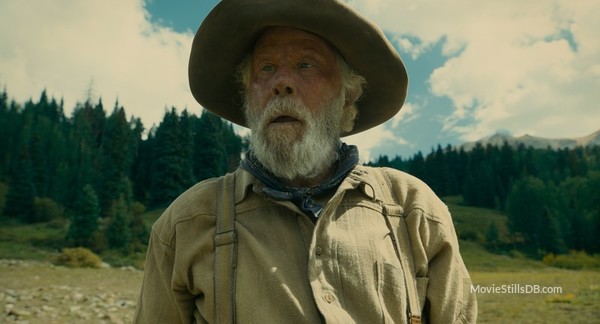
Two of the six stories that rank higher for me are All Gold Canyon, with Tom Waits (pictured), and The Gal Who Got Rattled. Both of these are based on short stories, from Jack London and Stewart Edward White respectively, while the others are original stories from the Coen brothers. All six stories have attracted a starry cast, including Tim Blake Nelson, James Franco, Liam Neeson, Zoe Kazan, and Brendan Gleeson (well, he’s starry to me anyway).
The cinematography is stunning, as it should be considering the canvas on which the stories are unfolding. The wide expanses of the prairies look dangerous in The Gal Who Got Rattled, which ably captures their panoramic vastness, and the beauty of All Gold Canyon’s natural wonders was like slipping into a secret pocket of paradise. Bruno Delbonnel as director of photography knows how to frame a shot. However, at times, the colouring was distractingly artificial. This is the first film the Coens have shot digitally, which presumably allows for this kind of play with colour, and while it mostly worked, some of the hues seemed a tad strange.
The recurring use of folk songs throughout the stories is one of the enjoyable small strands that is threaded through these tales. Carter Burwell is the man in charge of the music, and these lilting and bittersweet tunes, whether sung by characters or played as refrains, are a pleasure (and hearing Liam Neeson sing ‘The Sash’ was very amusing).
The stories themselves are bleak variations on a morbid but eternal theme. Perhaps most clearly so in Meal Ticket or The Gal Who Got Rattled. In Meal Ticket, which was grim and sparsely told, a young Artist (a wonderful Harry Melling) and his minder (played by Neeson) travel the country together making money as an entertainment duo. The limbless Artist orates, and Neeson handles the hauling, and the business. The Artist, beyond his impressive oratory of key speeches from Shakespeare and history, does not speak outside of these performances. To Neeson, the Artist is purely a commodity, who can be replaced with another commodity that reaps greater profit. The Artist is an attraction and has lost his personhood. His lack of meaningful voice is equated with Neeson’s inability to conceive of him as a person possessing dignity or spiritual worth.
The Gal Who Got Rattled, meanwhile, kicks off as a romantic comedy on the Oregon wagon trail. Zoe Kazan and Bill Heck perform a touching love story, that takes a tragic turn, and Grainger Hines offers sagacious life experience as Mr Arthur.
With its common thread of death the stories are spaces to explore different themes. All Gold Canyon, in which a terrific Tom Waits is a determined gold prospector, seemed to me a tale of exploitative capitalism. It reminded me powerfully of Jonathan Raban’s piece ‘Second Nature‘ (which is wonderful and absolutely worth a read). The prospector comes upon virgin land, and admires it as such, and yet sees it for the profits it holds secret. However, Waits’ prospector is also a lovable character, and as we watch him develop a relationship with the land, we can begin to respect an intuitive and sustainable connection with the natural world. The mysterious and threatening stranger, who wants only to take what Waits has worked for, is representative of the worst rampages of capitalistic consumption and expansion – in which there is no fair relationship between effort and reward.
Of the six parts, some are more and some are less successful. The Mortal Remains, the final story of the anthology, doesn’t come together for me. It may be that I missed the intended continuity between the character of ‘The Frenchman’, who appears in the first and last stories. This point of orientation was originally intended to be played by the same actor, and without this obvious hint, the fact that these were the same character was entirely lost on me. However, this final story also seemed discordant in its plot beats and the lurching tone sat uneasily with me. The lurid colouring struck me as cartoonish as well, going back to my earlier complaint about the look of the film.
Beyond the colouring, and the hit-and-miss quality of the stories, two particular complaints strike me about the film. One is the role of women, which is fairly minimal. The other is the representation of Native Americans, who appear entirely as ‘savages’ from the perspective of White Christianity.
The Ballad of Buster Scruggs is something of an experiment, and it is not entirely successful. Certain stories worked beautifully, while others left me cold. Perhaps it was the anthology structure which didn’t work for me, but it remains an intriguing project nonetheless.

 A Room With No View