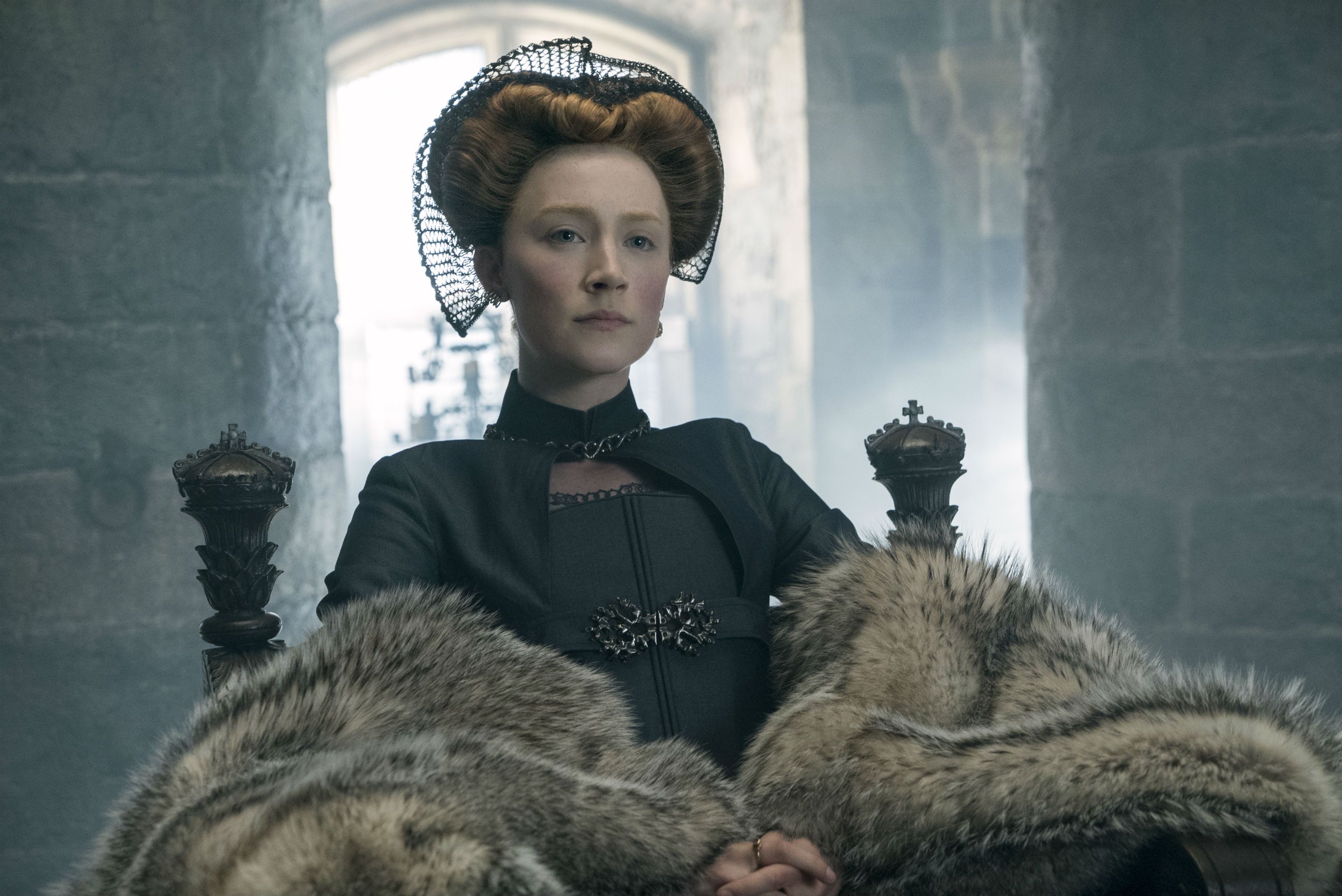
Mary Queen of Scots presents the Tudor tale of Elizabeth I of England, and Mary, Queen of Scots. Cousins biologically, but sister queens. It is an historical epic, that finds sumptuous reinvention in Josie Rourke’s wonderful new film. The saga of the twin queens, figureheads of north and south, offers huge scope for an adventurous film-maker. There is so much that can be conveyed through the continual juxtaposition of these two female monarchs, figureheads in John Knox’s feared ‘monstrous regiment of women’.
Mary and Elizabeth are presented as opposing forces, a binary suggested by decisions in the use of light and colour, and by clever production design. Elizabeth appears in the bucolic idyll of England, or in interior settings that offer plentiful natural light, we see her in the carefully manicured surroundings of English gardens or the refined and formal magnificence of palace architecture. Mary emerges from darkly coloured scenes, in castles hewn from the rockside. Mary’s Scotland is presented to us as natural, supernatural almost. The implication is clear: Mary is wild and untrammelled nature, Elizabeth is tame, confined by a cautious temperament. These decisions accomplish a feat of visual story-telling.
Josie Rourke is primarily a director of theatre, and there are evident theatrical touches throughout. One scene which could be ripped straight from the boards shows a wild Scottish pantomime of the hunt, dripping with predatory erotism. Rourke also adopts the fiction of a meeting between Mary and Elizabeth, which is played through sheets of drying linen, as Mary and Elizabeth shyly circle each other like courting lovers. The meeting, which is pure speculative fantasy, works as a cathartic outlet for the audience too.
Meanwhile, the imagery of blood pervades the film, whether in the globulous shine of ink dropping from a nib, in the flush of childbirth, or in the poppies dextrously worked in paper by Elizabeth and her ladies-in-waiting. The film is not afraid to obviously resort to image.
Margot Robbie initially seemed like left-field casting to me (and perhaps still does), but Robbie is an accomplished actress and she delivers a touching performance. David Tennant as the rabid John Knox gives a memorable turn in a small role. One welcome feature is the diversity of the cast. It is becoming increasingly unacceptable that period films should simply be assumed to require an entirely White cast, and Adrian Lester and Gemma Chan take on solid supporting roles.
However, I can’t talk about performances without Saoirse Ronan’s magisterial central performance sucking up all the encomia in the room. Ronan is the driving force behind everything, she is life and death in a film that lived or died by her hand. She is fierce, playful, fun, and determined as Mary. Her Scottish queen is both callow and canny. She stands apart from the rest of the cast, and indeed every other mere mortal in her orbit (too much?).
Mary Queen of Scots is a lavish production, part lusty romp, and all Tudor tragedy. It is blood and it is guts. Josie Rourke has created a monument to these characters and Saoirse Ronan is the raw power behind the throne.
4/5


 A Room With No View