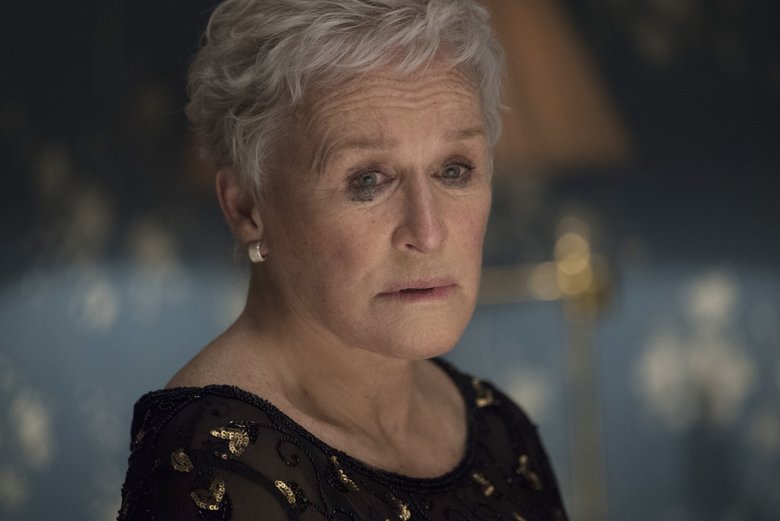
The Wife focuses on the comfortable theme of the wonderful women behind society’s ‘great men’. Except it doesn’t. Director Björn Runge establishes this familiar set-up, and then swipes the rug from under our feet just as we’re getting to grips with the plot. The Wife is, rather, an intense psychological portrait of a woman, and her marriage. The titular wife is Joan Castleman, played by a magnetic Glenn Close. Her husband is noted man of letters Joe Castleman, played by a wonderful Jonathan Pryce. Joe has been awarded the Nobel Prize for Literature, necessitating a Castleman family trip to the city of Stockholm.
Right away, there are curious notes to the marriage. Joe receives the phone call from the Nobel people early in the morning. Drowsy from an anxious night of sleep in his Connecticut home, he asks that Joan listen in on the other line. As her face falls into an expression of pain, we know that all is not well.
Joan and Joe take their son David along for the Swedish family jaunt. David is a writer too, eager for his father’s approval and struggling with the family legacy. While traversing the Atlantic by Concord (the film is set in the early 1990s), we meet Christian Slater’s Nathanial Bone. Bone is a hack, wading about in the shallower waters of the literary world, and keen to secure Joe’s approval to write his biography. Joe disdains this mercenary writer, but Joan seems to feel some sympathy for him, and how he is treated by her high-handed husband.
Once landed in Stockholm, the rifts between Joan and Joe that were suggested at the outset begin to widen. It is all too obvious when Joan is condescended to by the obsequious Nobel greeters, who offer her shopping and beauty treatments while her husband is occupied with grander matters. It is clear in the way in which she cringes as her husband introduces her. Curiously, although we may distrust him, Joe is adamant in his introductions, he is fulsome in his praise of Joan, he comes across as desperate to have her recognised. Yet these strangers whom she meets evince very little interest in the wife of the literary superstar. On meeting the recipient of another award, Joan is sized up by a fellow ‘wife’. This wife’s glance is at once appraising, wry, and cruel – it conveys a knowledge of the role of ‘the wife’. Her support of him is hinted at strongly in his inability to survive alone. During the moments Joan and Joe are apart, he is physically and morally weaker. Without her, he flags. Joe is a man who takes up an awful lot of emotional space.
At this point in the film, I am wondering… what does this woman do? The wife, our protagonist… who exactly is this woman?
Because in the meantime I’m getting a fairly good idea of who he is, this fêted giant of American literature. He humiliates his son as he introduces him. He wears the guise of self-deprecating homespun charm as he targets his son for a cheap laugh. He really is a wonderful portrayal of male entitlement with his pomposity and faux humility. Still, he continues to introduce Joan to everyone, determinedly, he is certain she shall be acknowledged.
At this point, the film takes a look to the past, to how Joan and Joe met. These aspects of the film are a disappointment after the ratcheting tension of the present. We learn that the intriguing couple met in 1958. He was a married lecturer. She was his student. He was, you’ll be shocked to learn, one of those awful men who complain about their family to pretty young women.
We now know that Joan’s role has changed over the decades. When they met, she wrote. Now, when asked if she writes, Joe resolutely answers for her in the negative. As she notes herself, everyone needs approval to write, and for Joan, this approval was never granted.
In effect, Joe has created a role for Joan, that of ‘the wife’, and in this role she is as wooden as the characters he creates on the page. Glenn Close plays this role as an inscrutable, locked box and her eruptions, when they break through, are sensational. As pressure is applied by the interventions of Christian Slater’s amoral Nathanial Bone, and as we inch closer to the Nobel ceremony, decades of silence explode and destroy. The music builds towards a powerful dramatic finale. Through the ceremony itself, the score competes with the triumphalism of the ‘in film’ music. It is discordant, and rising to a point of unbearable tension. Ultimately, The Wife is a slow-burner with an entirely worthy pay-off.
A fascinating two-hander. Close and Pryce deliver a convincing and brutal portrait of a marriage under strain and delve into the resentments that accompany success.

 A Room With No View