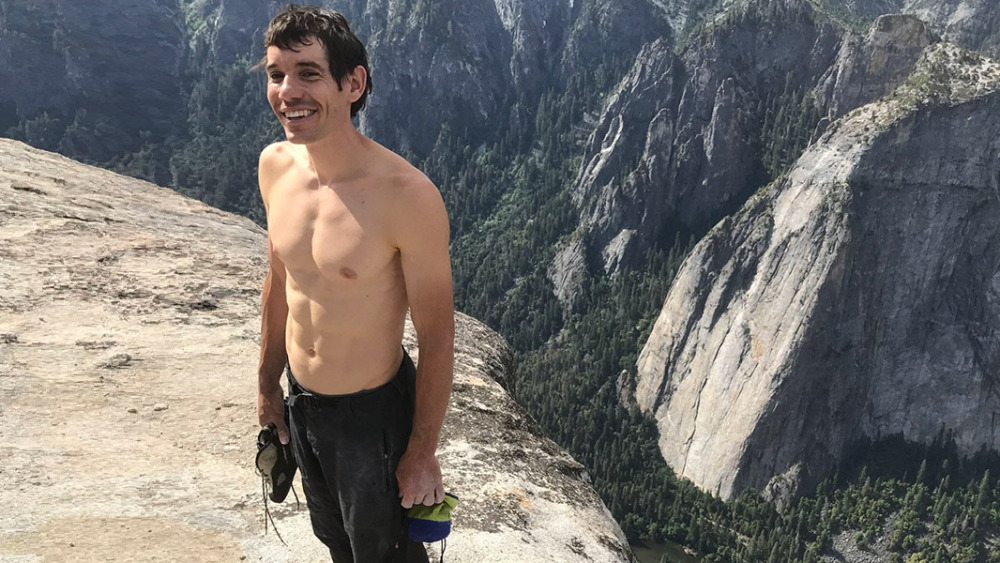
At some point towards the end of Free Solo, a documentary charting Alex Honnold’s attempt to free climb Yosemite’s vertiginous El Capitan, I realised that it was a mistake to have come to the cinema without Googling to see whether this guy had survived. I also happened to go see it with a friend who has a thing about heights, so she was looking away for some crucial moments when things got particularly anxiety-inducing.
This visceral reaction is absolutely a testament to the skill and care of directors Jimmy Chin and Elizabeth Chai Vasarhelyi that has delivered this quite incredible feat of film-making, as well as to the inconceivable talents of free climber Alex Honnold. Free Solo won the Academy Award for Best Documentary Feature at last Sunday’s Oscars, and it’s a well-deserved award for a breathtaking film.
Free Solo tracks not only Alex’s challenge against the rock face (3,200 feet of granite), but also follows his navigation of more quotidian concerns, notably his relationship with his girlfriend Sanni McCandless. The twin approach to this story, the granite ascent and the purchase of white goods for a new home, blend seamlessly to create a sensitive portrait of an exceptional person. This, clearly, is an interesting time to have such unfettered access to his life, as he contemplates a career-defining goal, while undergoing significant shifts in his personal life.
I’d previously hugely enjoyed the documentary Valley Uprising which explored the cultural history of free climbing and concentrated on the ‘scene’. Free Solo narrows its focus to tell a very personal story, showing Alex with Sanni, his mother, and close friends, all of whom have had to accept the risks inherent in following these pursuits.
One of the most intriguing aspects is the extent to which this is truly reflexive film-making. The director and crew worry, with cause, about the very literal damage the observer effect could wreak. A falling rock, loosened by a camera-man hanging high above, could cause Alex to fall. A discussion about suitable camera angles for one very high-risk section is sobering. They discuss whether they should film from directly above, and Alex decides against, reasoning that nobody needs to see that. The ‘that’ in question is a perfectly framed and shot sequence of a man falling to his death. This camera crew are therefore embedded, and are an essential component of Free Solo. By necessity of course they are all experienced climbers and some are close friends of Alex. As he makes his ascent, one camera operator in particular cannot bear to watch. He keeps the camera trained on the distant figure, from ground level, as he turns away. There is a very blurred line here between documentary makers and subject, and no pretence of objectivity.
Free Solo works so well for a number of reasons: the sheer skill level of everyone involved and the co-operation between Alex and the film-makers, the personal story it tells alongside the mythic tale of humanity versus nature, and the fact that Alex Honnold is undoubtedly a fascinating subject. In scenes which follow him from nature to domesticity, Alex seems less like an accomplished athlete, and more like a wild forest child, brought to civilisation by well-meaning locals and instantly regretting it. The question on where exactly this drive comes from is fascinating, offering up a childhood from which grew an obsessive desire for perfection.
What we’re left with, at the end, is an unfathomably gigantic slab of rock, and a thrilling account of a climb. One sequence, in which he provides narration over film of his climbing is wonderful. He is a clear communicator, ably explaining a treacherous pitch dubbed ‘the boulder problem’. He practices, doing the climb with ropes and fellow climbers, charting his findings in his climbing journal, and reciting reminders for holds like a rosary. He knows this is crazy. He rules out certain moves as too outrageous. He says maybe you could hope to ‘squeak it out’ on a good day, but only if you had nothing to live for. He wants to live, but he must climb.
Free Solo is at once an intimate glimpse of an extraordinary life, and a fantastic achievement in film-making. It’s a wonderfully physical film experience.

 A Room With No View