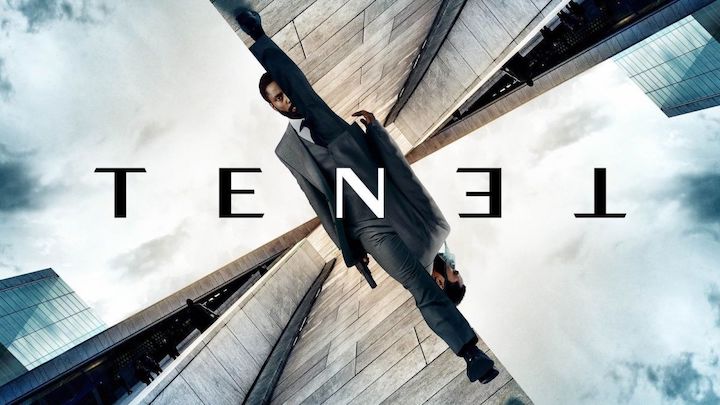
This film is very much designed to be seen cold. The following review avoids spoilers, per se, but is recommended to be read post-viewing…
Having completed the perceived one-for-us, one-for-you agreement with Warners following the Dark Knight Trilogy’s completion, Christopher Nolan essentially has cart blanche to continue with his specific brand of head-scramblers. Dunkirk may have seen him lean towards a more conventional subject matter, but he still couldn’t resist the temporal shifting and sleight of hand that has become his trademark.
Editors have struggled with synopses for his latest thriller. The fact that previews hinted of an ‘afterlife’ angle is the first of a couple of misdirects. As with many similar sci-fi properties, the mechanic of the science fiction element requires a little Basil Exposition, delicately and effectively delivered here by Clémence Poésy. However, even this interesting – if difficult to digest – reverse entropy aspect isn’t quite as it appears.
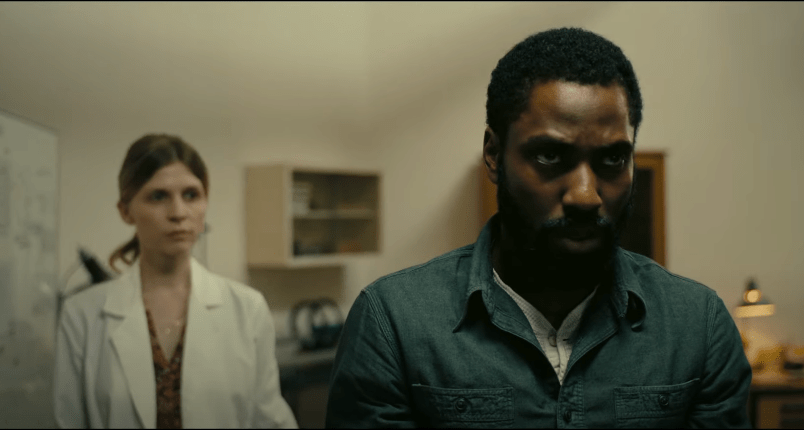
The first hour is intentionally opaque – the over-complication of plot, fast and dense dialogue, often obfuscated by masks or Michael Caine, all lead to a state of (seemingly) deliberate confusion. It’s like trying to picture a completed jigsaw, when you’ve been thrown a few pieces, and no box.
The sci-fi component is initially sparse, and when it is reintroduced in the telegraphed motorway scene, it doesn’t sit quite right. Something’s off – the way it was explained doesn’t corroborate with what you’re seeing. There’s a missing piece. The (quite literally) pivotal scene that sets the second half in motion is as exhilarating as it is confounding; the whole jigsaw is suddenly revealed. We get the box. In Nolan we trust…
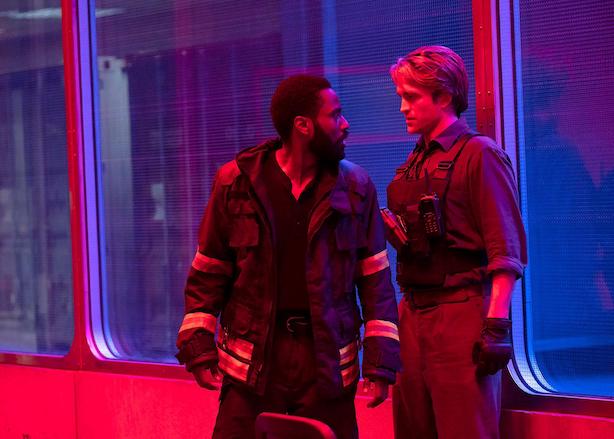
From here on in we’re on a rollercoaster where you’re constantly second-guessing and doing the mental gymnastics required to make sense of the plot progression, and – more thrillingly – the physics of what’s unfolding. At the climax, there is the real problem that the brain isn’t physically able to compute all that is going on during the busiest scenes. This may well rob some satisfaction from the denouement, but will certainly be rewarded on repeat viewings. Whether or not this is an acceptable trade-off will be to personal taste.
Despite the globe-trotting nature, compared to recent escapades to outer-space, or the architecture of dreams within dreams, the action does feel more restricted; car chases, fist fights and explosions. The commitment to practical effects gives a bone-shaking weight and physicality – Nolan has spoken at length of the benefits of such an approach, and it continues to pay dividends.
The cast are excellent. Washington provides a stoic, choric role at the centre of all the chaos. Elizabeth Debicki is phenomenal; strong but fragile, and as much of a motivation to Washington’s Protagonist as the (admittedly) awkward McGuffin. Branagh is in full-on menace mode, and provides a genuine threat that hushes any conversation as to whether the accent was a good idea. Finally, Pattinson is a real highlight, bringing a touch of welcome levity; there are small but appreciated moments of humour, rarely glimpsed in Nolan’s canon.
It won’t do much to convert Nolan critics – the first half in particular is dense and difficult, with action beats that only truly pay off later on. But after this course is reversed, you’re given a truly unique experience, with all the cerebral exercises you’ve come to expect from a Nolan assignment. Nobody else is making films like this, at this scale.
Martin

 A Room With No View
This has been described twice as ‘lovely’, which is the exactly the writing style I aim for.
LikeLike